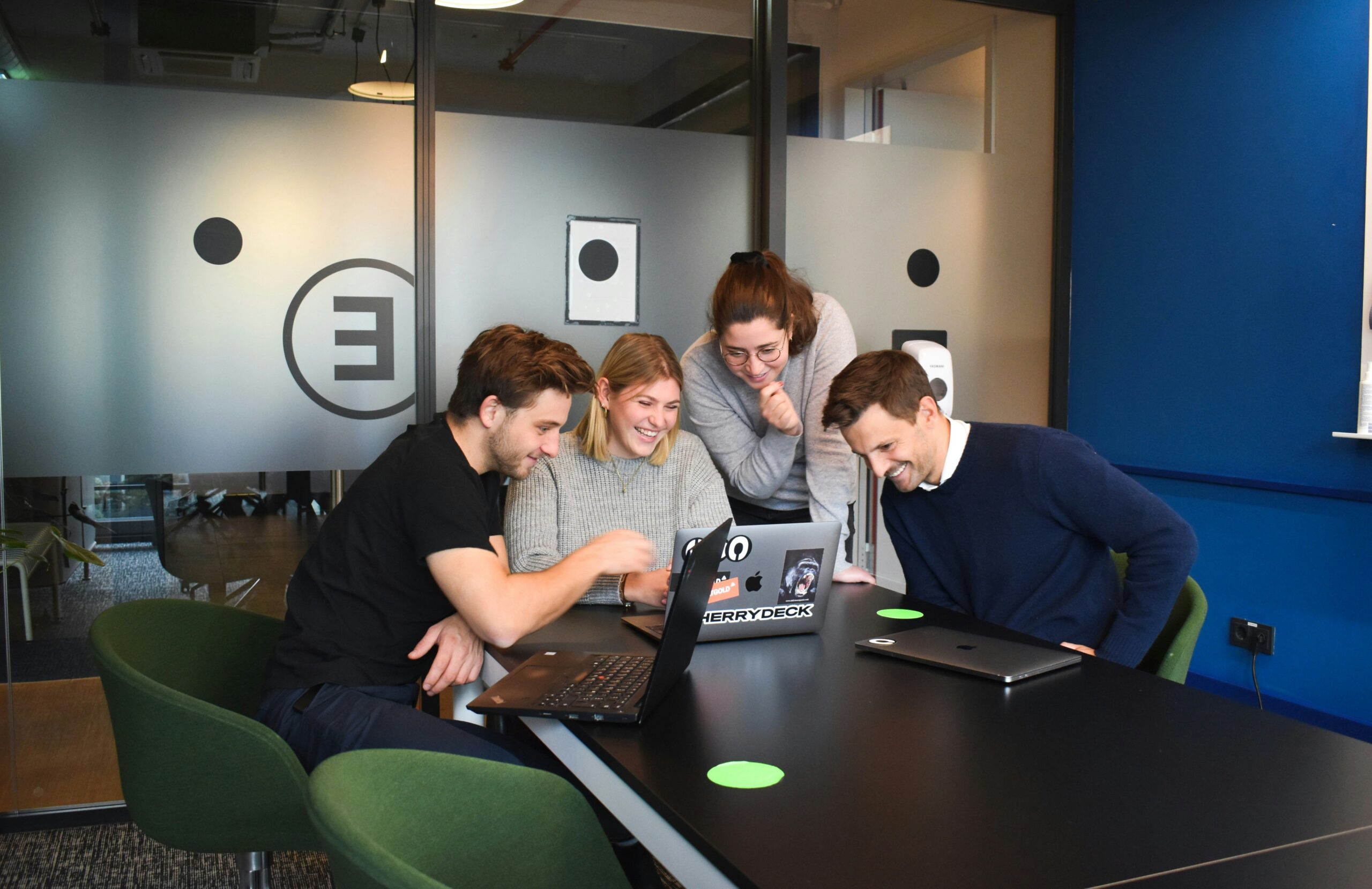
Drafting, rewriting, and summarizing: AI has become part of everyday practices. Yet when communications professionals are asked which skill they value most in their profession, teamwork ranks first, ahead of creativity and technical expertise.
2
This paradox says a great deal about the transformation currently underway: the more AI becomes embedded in communicators’ daily work, the more the ability to work effectively together becomes a strategic asset. Indeed, generative AI is not just a tool for individual productivity. When properly integrated, it can also become a driver of collaboration, knowledge sharing, and the transformation of workplace practices.
Generative AI and Internal Communications: Unlocking New Ways to Collaborate
Quand il s’agit d’IA générative en entreprise, le premier réflexe est souvent de la considérer comme un outil de productivité individuelle : rédiger un premier jet plus rapidement, résumer un document ou rechercher une information en quelques secondes.
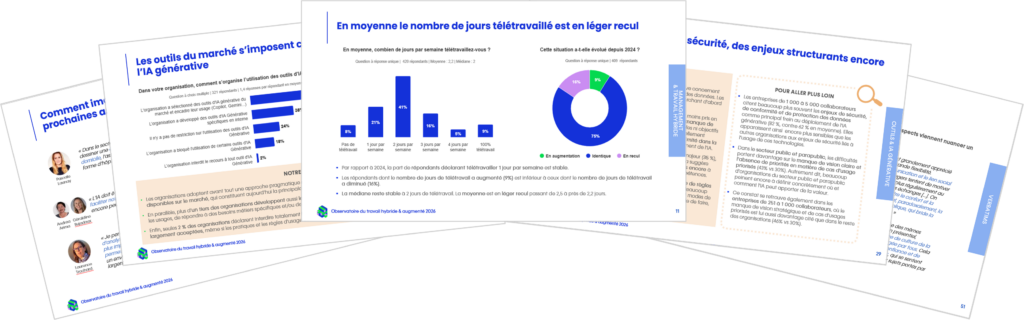
Les communicants ne font pas exception. Selon notre Observatoire du travail hybride & augmenté 2026, 82 % des répondants utilisent déjà l’IA générative pour créer, reformuler ou synthétiser des contenus, et 66 % pour rechercher de l’information. Cependant, le potentiel de l’IA ne se limite pas à faire plus vite ce que chacun faisait déjà seul. En prenant en charge certaines tâches à faible valeur ajoutée (compte rendu, synthèse, reformulation…), elle peut aussi libérer du temps pour les activités collectives : confronter les idées, réfléchir, décider et créer ensemble.
L’enjeu n’est donc plus seulement d’intégrer ce que l’IA permet à chacun de produire, mais ce qu’elle permet à l’équipe de mieux faire ensemble.
Pour les métiers de la communication, où la coordination entre équipes, contributeurs et parties prenantes est centrale, cette dimension collaborative ouvre de nouvelles perspectives. Mais concrètement, à quoi ressemble cette utilisation collaborative de l’IA ?
Generative AI and Internal Communications: Three Practical Collaborative Use Cases
L’intranet offre un bon terrain d’observation de cette évolution. Selon notre Observatoire de l’Intranet Augmenté 2025 (526 répondants), 51 % des organisations étaient déjà en phase de test ou de déploiement de l’IA générative dans leur intranet. Au-delà des gains de productivité individuelle, nos études et les témoignages recueillis auprès de professionnels font apparaître plusieurs usages où l’IA peut directement soutenir la collaboration.
Generative AI seems to me to be an opportunity to develop a stronger network of contributors on our intranet. I see it as a writing assistant that can reassure employees when faced with the anxiety of a blank (web) page or the fear of getting it wrong.
Expanding the Network of Contributors
Content contribution within an intranet often remains centralized, particularly because not all employees feel comfortable writing.
By making it easier to draft, rewrite, or structure content, generative AI can lower this barrier to contribution and enable more employees to share their expertise.
In this way, AI is not just about producing content faster: it can also help transform the intranet into a more collaborative space.
Enhancing Brainstorming and Collective Ideation
AI can also be used upstream of content production, when teams are exploring, challenging, and structuring their ideas.
Used during a brainstorming session, it can suggest new directions, challenge an initial approach, reframe ideas, or help organize them. In this context, it becomes a facilitator of collective thinking rather than simply a writing tool.
The value lies less in the answer generated by AI itself than in its ability to fuel discussion and stimulate the team’s creativity.
We need to reassure communication teams and help them understand that AI is an enabler. It saves time and can, for example, be used to support brainstorming sessions.
We integrated a generative AI feature into our intranet to help users find content more easily. Implementation was relatively quick, as the AI queries a structured content repository within a clearly defined scope. The results have been very positive, both for users and from a data management perspective.
Making Collective Knowledge More Accessible
Effective collaboration also depends on the ability to easily find what the organization already « knows »: published content, procedures, guidelines, or knowledge created by other teams.
6
When connected to an internal knowledge base, generative AI can make this collective knowledge more accessible by enabling employees to query existing content in a more natural and intuitive way.
However, the quality of the responses generated depends directly on the quality of the content the AI can access. As a result, relevance, structure, content freshness, and governance become critical success factors.
AI can therefore improve the way communication teams work together, but these benefits do not come automatically. They require organizations to rethink certain processes and establish a shared framework for use.
How Generative AI Is Changing the Way People Work Together
These new use cases are not simply about adding another tool to existing practices: they also challenge the processes, roles, and operating principles that shape how teams work together.
Which tasks should be delegated to AI? When is human review required? Who remains accountable for the final content? Which uses and data require clear governance and oversight? These questions become essential as soon as AI becomes integrated into collaborative work.
Notre Observatoire du travail hybride & augmenté 2026 le confirme : l’absence de cadre de gouvernance clair reste un frein à l’adoption de l’IA générative pour 35 % des répondants. Et 43 % des managers estiment que son utilisation nécessite un contrôle accru des contenus produits par leurs équipes.
AI does not always fully understand the context, which is why caution remains essential. Human skills such as critical thinking, empathy, and a nuanced understanding of context continue to be fundamental.
Making AI a truly collaborative tool therefore requires rethinking certain ways of working and collectively defining the rules of engagement, without losing what creates value within a team: expertise, critical thinking, and a deep understanding of context.
To go further
At Arctus, we approach AI with the same conviction that guides our workplace transformation and Digital Workplace projects: start with the needs and practices of teams, rather than the technology itself.
The challenge is not simply to identify what AI can automate, but to understand how it can improve the way people create, share knowledge, and collaborate. This means identifying high-value use cases, while also evolving certain processes, establishing an appropriate governance framework, and supporting teams in adopting new ways of working.
The true potential of generative AI therefore lies not only in helping each communications professional work faster, but in how it can help teams work better together.
Would you like to identify the most relevant generative AI use cases for your teams? Get in touch with our consultants.
What if you took a step back and looked at the bigger picture?
For more than 15 years, Arctus has been tracking changes in the workplace and the evolution of the digital employee experience. Intranets, AI, collaboration, management… Discover the key trends, insights, and real-world experiences from our Observatories to inform your thinking and help you anticipate the transformations ahead.
✨ Facilitez votre veille sur l’expérience collaborateur et l’IA : abonnez-vous à la newsletter d’Arctus.
Nous utilisons des cookies pour vous garantir la meilleure expérience sur notre site web. Si vous continuez à utiliser ce site, nous supposerons que vous en êtes satisfait.