The 5 Key Findings of the 2026 Hybrid Work Observatory
Patricia Ranaivosoa
8 June 2026
Four years after the launch of the Hybrid & Augmented Work Observatory, Arctus is publishing the 2026 edition of its biennial study dedicated to the evolution of working methods and the impact of digital technology on organizations.
This new edition marks a turning point: after a phase of rapid expansion of remote work between 2022 and 2024, organizations are now entering a phase of stabilization of hybrid work models… while generative AI is emerging as the new driver of work transformation.
1. Remote work is stabilizing at around 2 days per week.
The hybrid model has reached a point of equilibrium.
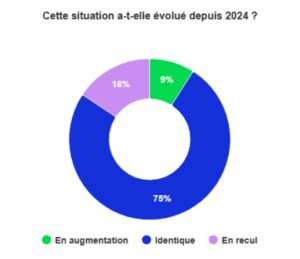
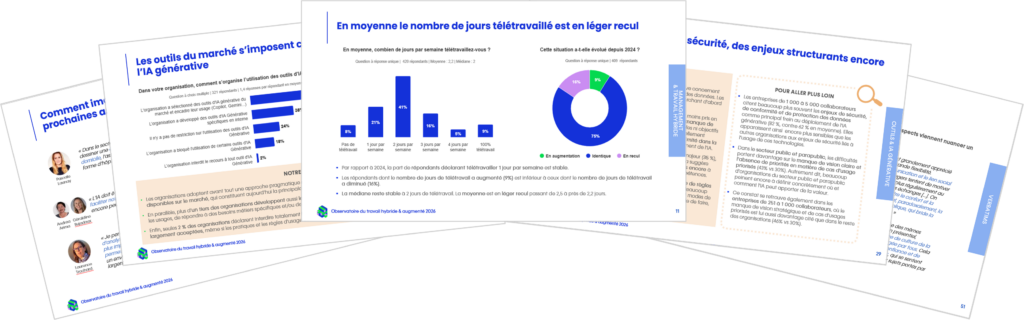
In 2026, respondents report working remotely an average of 2.2 days per week, compared with 2.5 days in 2024. The median remains stable at 2 days.
The issue is no longer so much “how much” as “how.” Hybrid work is gradually ceasing to be merely an organizational arrangement and is becoming a cultural, relational, and managerial challenge.
“Flexibility is now considered a lasting feature of the professional world: 74% of respondents believe it defines the future of work, while more than one in two employees say they would be willing to leave a company that eliminates remote work.”
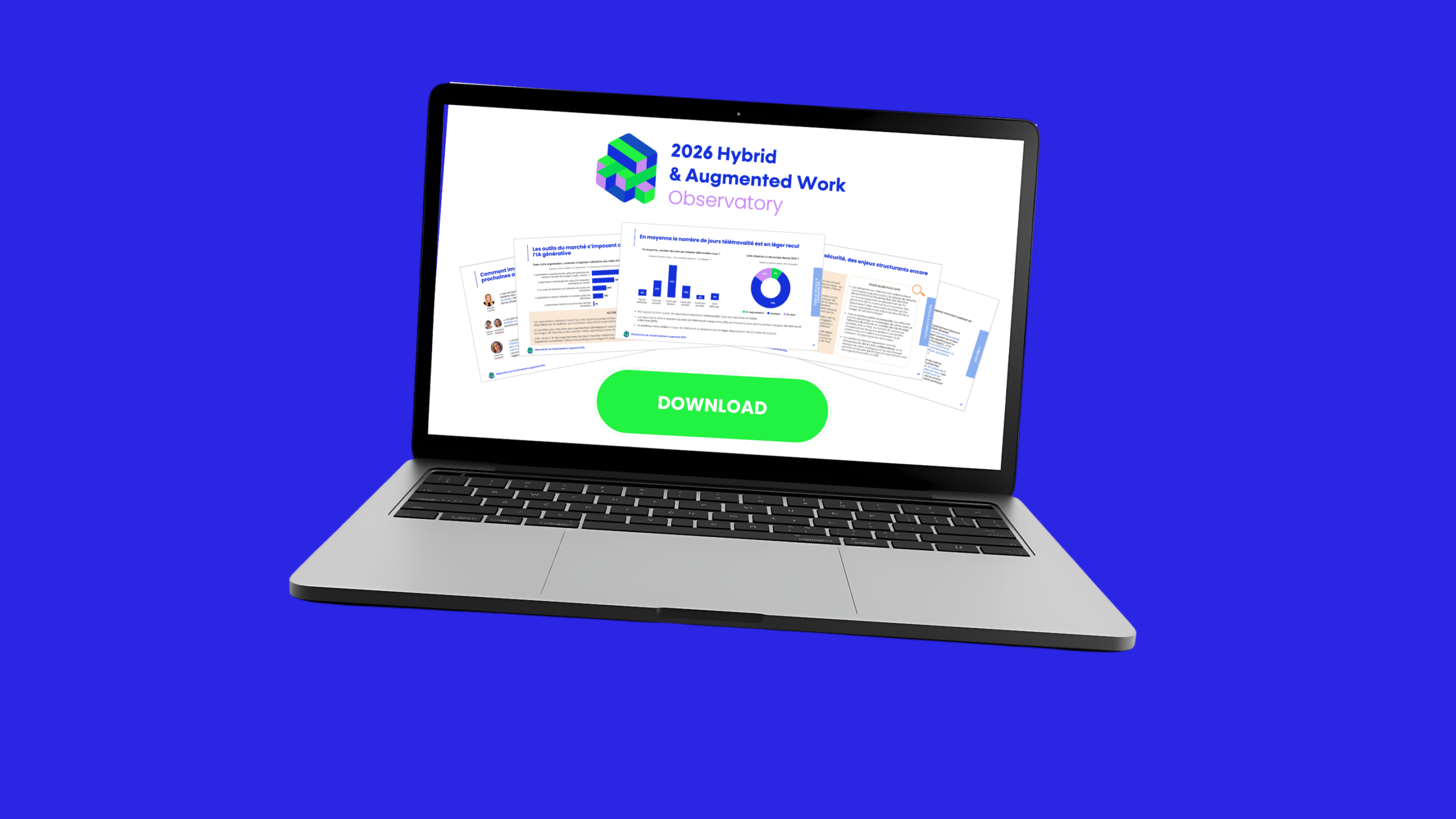
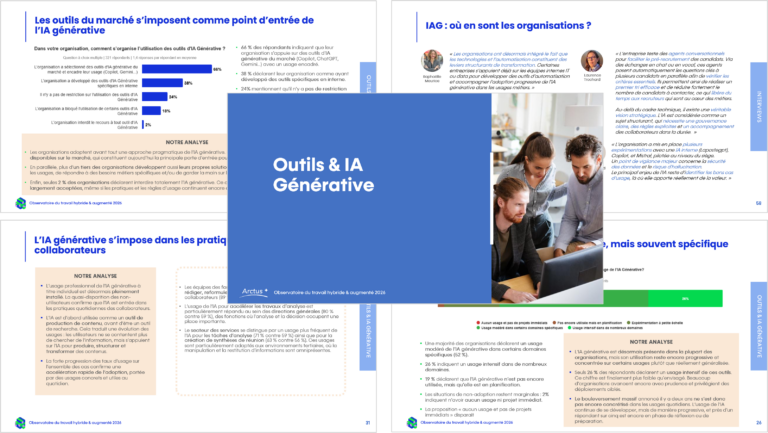
Want to go further? The full report brings together all the key figures, cross-analysis insights, and numerous professional testimonials on a range of topics (hybrid work organization, management evolution, AI, etc.). A wealth of insights to enrich your thinking and help evolve your work practices.
2. Hybrid Management Is Shifting Its Priorities: People Before Technology
The study shows a significant improvement in managers’ adaptation to hybrid work: 72% of respondents now consider their management to be well or very well adapted, representing an increase of nearly 20 percentage points compared with the previous edition.
More importantly, expectations are changing significantly.
The skills considered most critical for the hybrid manager are no longer technological, but rather human-centered:
Communication,
Maintaining social connections,
Trust,
Team cohesion
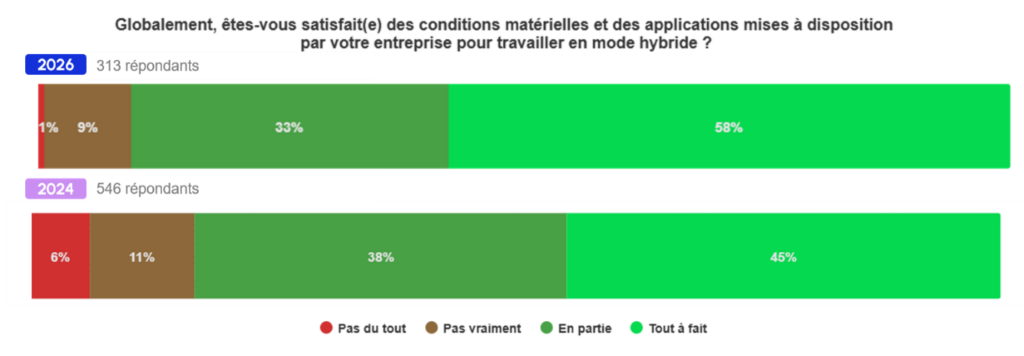
Digital tools are now viewed as commodities. Collaborative practices are widely established, and respondents generally consider themselves well equipped to work in a hybrid environment.
In increasingly technology-enabled work environments, the value of management now lies more in interpersonal skills than in mastery of tools.
3. Generative AI: An Everyday Tool
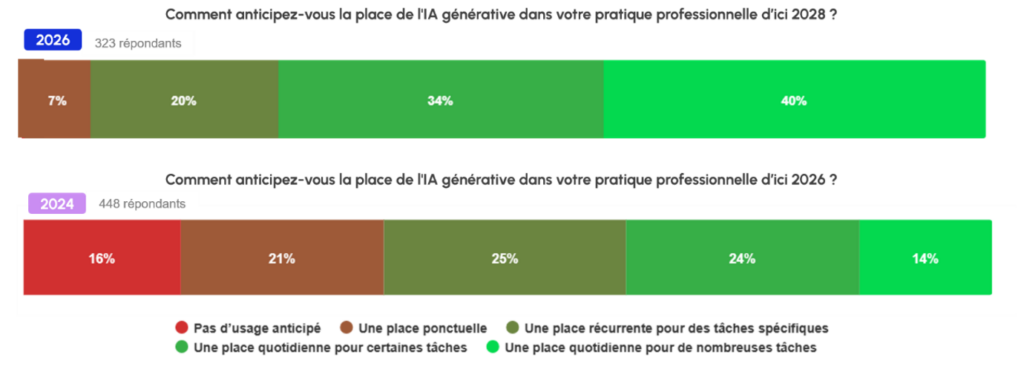
L’Observatoire 2026 montre l’accélération spectaculaire de l’intégration de l’IA générative dans les projections des professionnels.
Alors qu’en 2024 les usages apparaissaient encore exploratoires, les répondants envisagent désormais une présence importante de l’IA générative dans leur quotidien professionnel :
3 répondants sur 4 anticipent un usage quotidien d’ici 2028,
96 % déclarent déjà utiliser des outils d’IA générative à titre professionnel.
However, this acceleration is also accompanied by a growing risk of work intensification: productivity gains could lead to faster work rhythms and increased production volumes.
“Using generative AI does not actually save time. It accelerates the pace of production and, in doing so, creates room for more activity. This intensifies the workday. Beware of burnout!”
Particularly interested in the topic of AI?
A dedicated section of the report explores the evolution of generative AI adoption in organizations, featuring:
In-depth analyses and cross-sectional insights by user profile
Real-world experiences from organizations at different stages of implementation
A strategic perspective to turn generative AI into a driver of engagement and performance.
“For Arctus, this 2026 edition marks a new stage in the transformation of work.
Following the hybridization of workplaces and collaboration methods, organizations are now entering a phase of employee ‘augmentation’ through generative AI.”
The challenge of the coming years will be twofold:
Leveraging the performance gains enabled by AI,
While preserving the human dimensions of work: collaboration, creativity, knowledge sharing, trust, and a sense of purpose.” Isabelle Reyre – Associate Director – Arctus
Access the Full Findings Discover all the results, detailed analyses, and insights gathered from professionals to better understand the transformations reshaping work, management, and organizations today.
About the Hybrid & Augmented Work Observatory & Augmented Work Observatory
The Hybrid Work Observatory is a biennial study launched in 2022 to measure and analyze the impact of digital technologies on the organization of work in a hybrid environment.
The survey was conducted among 420 respondents from 388 organizations, representing more than 5 million employees,
An online questionnaire was carried out from February 3 to April 17, 2026,
Qualitative one-on-one interviews were conducted with around twenty professionals.
✨ Facilitez votre veille sur l’expérience collaborateur et l’IA : abonnez-vous à la newsletter d’Arctus.
Nous utilisons des cookies pour vous garantir la meilleure expérience sur notre site web. Si vous continuez à utiliser ce site, nous supposerons que vous en êtes satisfait.