

24 March 2026
In the age of AI, organizations are facing a multitude of transformations that impact the geopolitical balance, that of the planet, of companies, and of course our own, particularly as workers.
This tsunami is accompanied by organizational transformations and major impacts: job destruction, task automation, new ways of working, reinvention of the professional framework, of expertise, and of added value.
From then on, a central question emerges: how to exercise one’s role as a leader and support teams in a context where AI transforms both work… and our way of thinking?
Some possible answers through three key shifts in leadership.
Courage, humility, compassion, and authenticity are now emerging as key qualities to enable fulfilling professional development for teams. What constitutes a notable advancement is the recognition of the human being in all their dimensions at work.
The 2024 edition of the Arctus biennial study dedicated to the impact of hybrid work on managerial practices confirms this trend: human-related challenges now take precedence over the sole mastery of digital tools.
In a context of increased uncertainty, leaders are encouraged to better understand their internal functioning in order to adapt it, and to shift from a reactive posture to a creative one. This conviction is also shared in the latest study “State of Organizations 2026” by McKinsey, which resonates particularly in the age of AI.
Furthermore, many models, including that of the Leadership Circle, integrate these dimensions and encourage leaders to consciously develop awareness of their leadership style. The objective: to better transform themselves and become enlightened leaders, capable of contributing to organizational transformation and leading their teams with awareness.
Augmented leadership is thus based on three major shifts:
Beyond this evolution toward more conscious leadership, deeper questions are emerging, calling for a reconsideration of the very nature of the value brought by individuals in an environment transformed by AI.
In a post published in November 2025, Dominique Turcq, a sociologist and futurist, invites us to reflect on the impact of AI on our minds and our ways of thinking.
To do so, he refers to the concept of “ecology of mind” used by Gregory Bateson in 1972. “One of the ideas is that any technological innovation brings changes in the way the human mind sees, judges, and interprets the world around it,” he tells us.
The rise of generative AI fully illustrates this dynamic. By producing content that we are not the originators of and by processing large volumes of data at lightning speed, our functioning will evolve, hybridize, and our vision of the world will also change.
Being aware of these mechanisms at work is essential to continue evolving in a world that is becoming ever more complex and where hybridization in all its forms is increasing.
From then on, the role of the manager evolves profoundly.
It is no longer only about supervising or coordinating, but also about:
As we can see, the challenges ahead, both as leaders and as human beings, are immense. In the face of these profound transformations, one question arises: how do organizations concretely structure these changes in their day-to-day work?
The transformations at work within organizations are at once technological, human, and cognitive. They call into question the role of the leader, but also the way companies concretely structure their operations.
With the rise of generative AI, work is entering a new phase of hybridization. This is no longer limited to alternating between on-site and remote work: it now incorporates increasing collaboration between humans and machines, particularly in content production, access to information, and decision-making.
In this context, organizations must simultaneously rethink three dimensions:
At Arctus, we observe that the most advanced organizations are those that address these three levers in a coordinated way, in close connection with their business and human challenges.
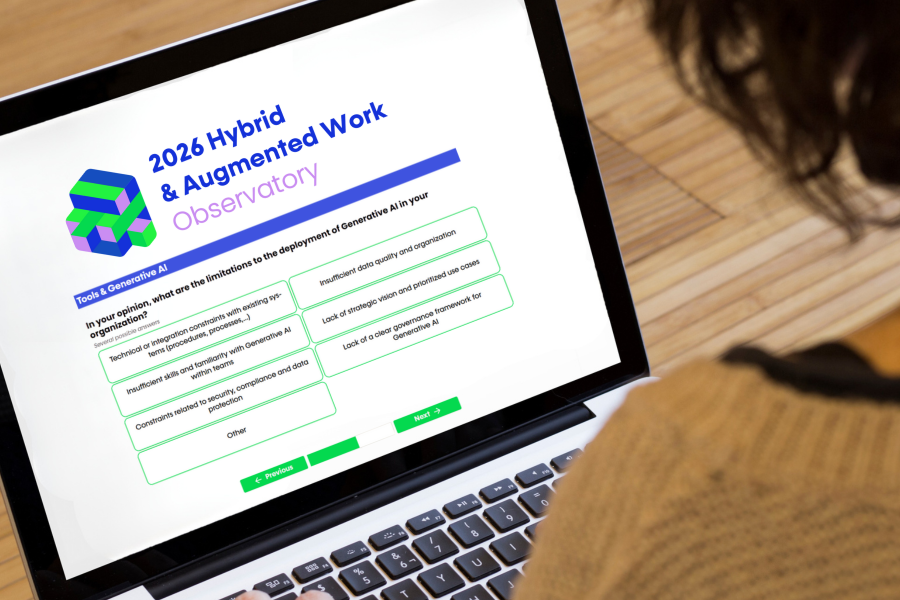
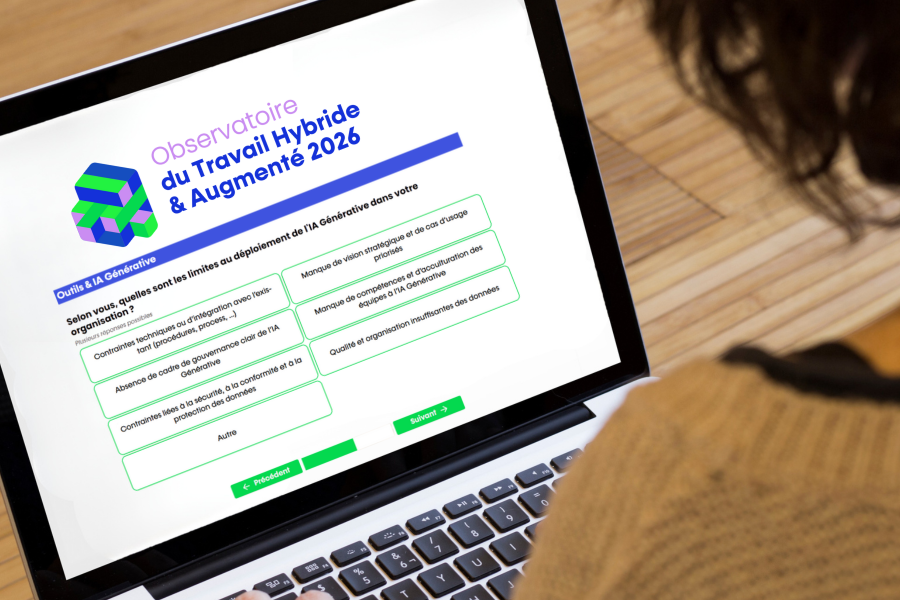
To explore these issues further and assess where your organization stands, take part in our Hybrid and Augmented Work Observatory 2026.
The Hybrid and Augmented Work Observatory 2026 is coming to a close.
Your perspective would help complement the nearly 300 responses already collected and enrich this analysis of ongoing transformations.
This edition explores three key dimensions:
By participating, you contribute to a collective analysis of ongoing transformations and gain access, as early as May, to consolidated results to inform your decisions.
Founder of Arctus, Partner
Founder and director of Arctus, Isabelle is also an author and speaker. Since 2007, she has shared her perspective and sheds light on the internal transformations that organizations are going through through studies and observatories such as the Hybrid Work and Digital Management Observatory, the Intranet & Digital Working Observatory or the creativity. She is also an administrator and an active member of AFCI, the French Association of Internal Communication Professionals.

|
✨ Facilitez votre veille sur l’expérience collaborateur et l’IA : abonnez-vous à la newsletter d’Arctus. |