
16 February 2026
Barely emerging from the health crisis, organizations were already experiencing a new wave of transformation: the global emergence of generative AI, with ChatGPT leading the way.
In 2026, where does hybrid work really stand?
Between the return to the office and the growing adoption of AI tools, a new phase is unfolding.
Longtemps, l’hybridation* du travail a désigné l’alternance entre présence au bureau et travail à distance. Aujourd’hui, elle dépasse la seule flexibilité des modalités de travail (présentiel, travail à domicile ou dans un espace de coworking, mobilité…). Elle intègre désormais un second mouvement majeur : le recours croissant aux outils d’IA Générative dans le quotidien professionnel.
Ces outils accélèrent la production, optimisent les tâches, transforment le travail et redessinent les rôles.
Le travail hybride devient ainsi à la fois organisationnel et technologique.
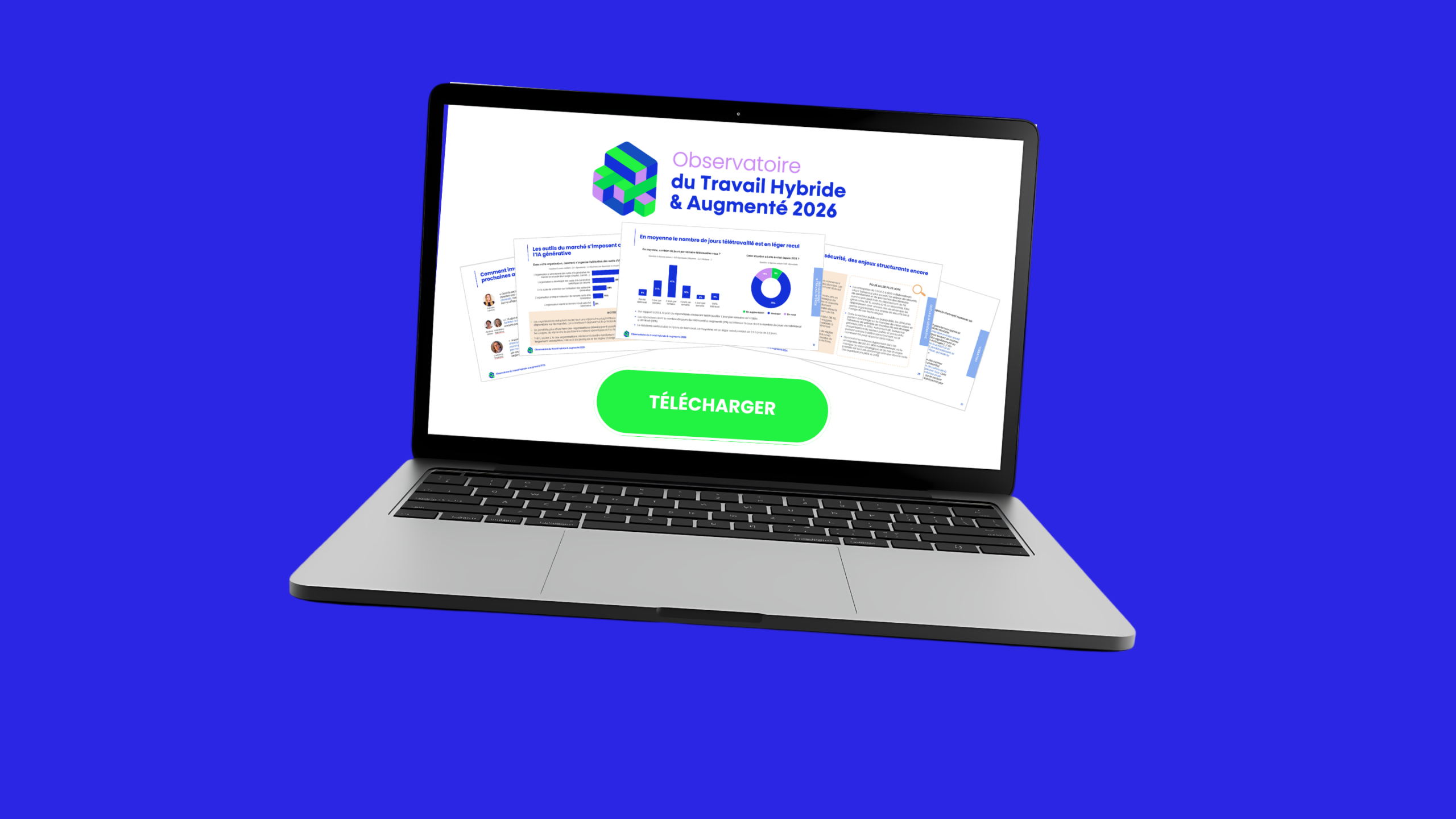
À travers l’Observatoire du travail hybride, que nous menons tous les deux ans, nous analysons ces transformations.
Le croisement des conclusions de l’édition 2024 et des évolutions récentes met en lumière une nouvelle phase :
Comment ces deux tendances ont-elles évoluées en 2026 ?
Depuis 2024, en France, la réduction du temps de travail à distance se confirme, dans de grandes entreprises comme dans des structures plus petites.
Les arguments avancés pour justifier ce recul sont récurrents :
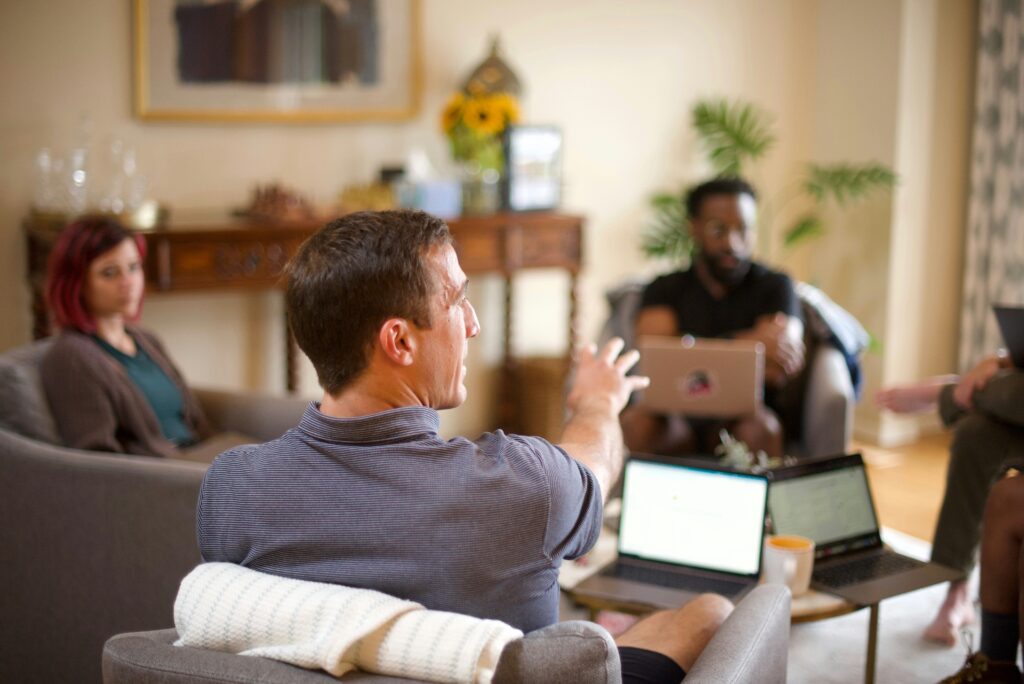
Le bureau redevient un lieu central, mais pour travailler différemment.
Several groups have adjusted their policies, including:
Les arguments avancés pour justifier ce recul sont récurrents :
Le bureau redevient un lieu central, mais pour travailler différemment.
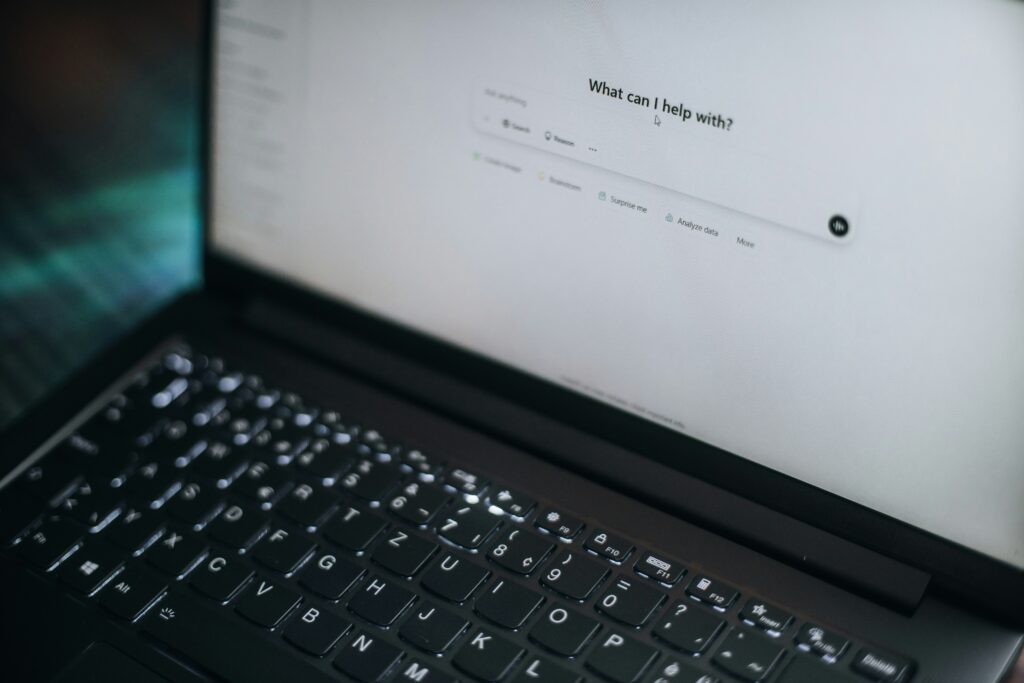
At the same time, employees’ toolkits are expanding with generative AI components.
Models are becoming more specialized: Large Language Models (LLMs) are giving way to Small Language Models (SLMs).
They are integrating with internal data (Retrieval Augmented Generation (RAG) deployed on qualified data clusters) and are gradually replacing underperforming search engines.
The world of work is becoming increasingly “technical”: low code, no code, prompting, autonomous agents…
Employees are producing faster and handling a greater number of tasks. According to studies by Harvard Business Review and OpenAI, new activities are emerging, expanding employees’ scope of action and range of responsibilities.
While workspaces are being redesigned and tools modernized and enhanced to improve working conditions and productivity, one challenge remains: adapting managerial practices.
Only one company out of two (53%) considered in 2024 that managers’ adaptation to hybrid work was satisfactory.
Managers must now contend with “doubly augmented” employees.
Employees now have access, on the one hand, to ready-to-use tools (such as ChatGPT or Gemini) and, on the other hand, to agents they design and configure themselves according to their needs.
In this context,
Hybrid work is therefore no longer just a matter of presence. It has become a question of steering, organization, and regulation.
*Hybridization refers to the act of combining two elements of a different nature to create a system that blends their characteristics.
Share your experience by taking part in the 2026 edition of the Hybrid Work Observatory
⏱️ It only takes 10 minutes to contribute
📊 Results will be shared in May 2026</
Founder of Arctus, Partner
Founder and director of Arctus, Isabelle is also an author and speaker. Since 2007, she has shared her perspective and sheds light on the internal transformations that organizations are going through through studies and observatories such as the Hybrid Work and Digital Management Observatory, the Intranet & Digital Working Observatory or the creativity. She is also an administrator and an active member of AFCI, the French Association of Internal Communication Professionals.
|
✨ Facilitez votre veille sur l’expérience collaborateur et l’IA : abonnez-vous à la newsletter d’Arctus. |