
16 February 2026
Barely emerging from the health crisis, organizations were already experiencing a new wave of transformation: the global emergence of generative AI, with ChatGPT leading the way.
In 2026, where does hybrid work really stand?
Between the return to the office and the growing adoption of AI tools, a new phase is unfolding.
For a long time, work hybridization* referred to the alternation between working in the office and working remotely. Today, it goes beyond simple flexibility in work arrangements (on-site work, working from home or from a coworking space, mobility…). It now encompasses a second major shift: the growing use of generative AI tools in everyday professional activities.
These tools accelerate production, optimize tasks, transform work and reshape roles.
Hybrid work is thus becoming both organizational and technological.
Through the Hybrid Work Observatory, which we conduct every two years, we analyze these transformations.
By cross-referencing the findings of the 2024 edition with recent developments, a new phase emerges:
How have these two trends evolved in 2026?
Since 2024, in France, the reduction in remote working time has been confirmed, both in large companies and in smaller organizations.
The arguments put forward to justify this shift are recurring:
The office is once again becoming a central place — but to work differently.
Several groups have adjusted their policies, including:
The arguments put forward to justify this shift are recurring:
At the same time, employees’ toolkits are expanding with generative AI components.
Models are becoming more specialized: Large Language Models (LLMs) are giving way to Small Language Models (SLMs).
They are integrating with internal data (Retrieval Augmented Generation (RAG) deployed on qualified data clusters) and are gradually replacing underperforming search engines.
The world of work is becoming increasingly “technical”: low code, no code, prompting, autonomous agents…
Employees are producing faster and handling a greater number of tasks. According to studies by Harvard Business Review and OpenAI, new activities are emerging, expanding employees’ scope of action and range of responsibilities.
Si les espaces de travail sont repensés et les outils modernisés et étoffés pour de meilleures conditions de travail et une meilleure productivité, un défi demeure : l’adaptation des pratiques managériales.
Seule une entreprise sur 2 (53%) estime en 2024 que l’adaptation des managers au travail hybride est satisfaisante.
Les managers doivent, en effet, désormais composer avec des collaborateurs « doublement augmentés ».
Les salariés ont désormais accès, d’une part, à des outils prêts à l’emploi (comme ChatGPT ou Gemini), et, d’autre part, à des agents qu’ils conçoivent et configurent eux-mêmes en fonction de leurs besoins.
In this context,
Hybrid work is therefore no longer just a matter of presence. It has become a question of steering, organization, and regulation.
*Hybridization refers to the act of combining two elements of a different nature to create a system that blends their characteristics.
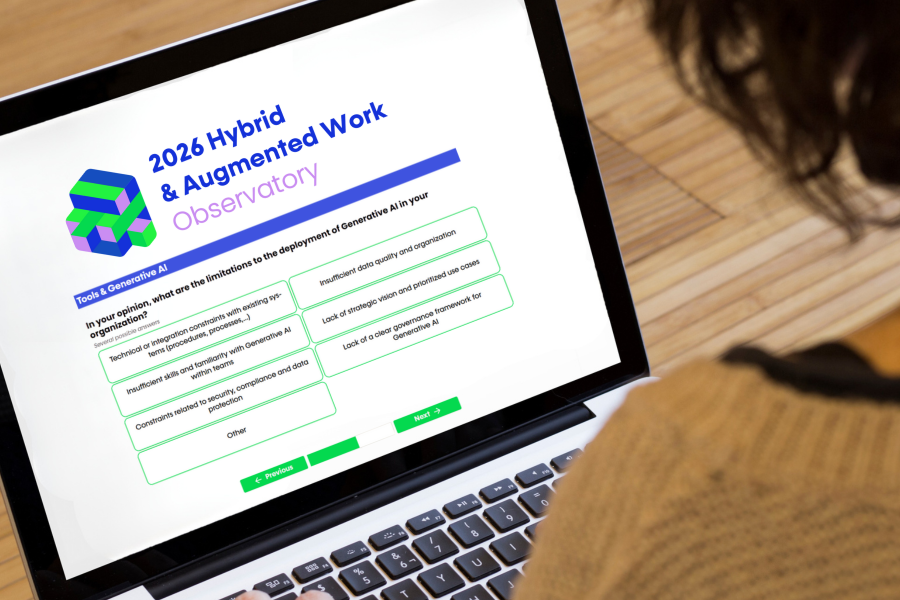
Share your experience by taking part in the 2026 edition of the Hybrid Work Observatory
⏱️ It only takes 10 minutes to contribute
📊 Results will be shared in May 2026</
Founder of Arctus, Partner
Founder and director of Arctus, Isabelle is also an author and speaker. Since 2007, she has shared her perspective and sheds light on the internal transformations that organizations are going through through studies and observatories such as the Hybrid Work and Digital Management Observatory, the Intranet & Digital Working Observatory or the creativity. She is also an administrator and an active member of AFCI, the French Association of Internal Communication Professionals.
|
✨ Facilitez votre veille sur l’expérience collaborateur et l’IA : abonnez-vous à la newsletter d’Arctus. |